History of Kwa Dukuza
Kwa Dukuza, also known as Stanger, is a town located in the Kwa Zulu Natal province of South Africa. The town was first established in 1875 as Stanger yet the Zulus named it ‘Dukuza’ many years before it was declared a town of ‘Stanger’. The town was founded by King Shaka, King of the Zulus, in July 1825 and he named it Kwa Dukuza, meaning ‘place of the lost person’ because of the capital’s complex labyrinth of huts.
After naming the town, Shaka settled in Kwa Dukuza and erected about 2000 huts with his hut at the centre of Kwa Dukuza.
Shaka also established camps in Uhlomendlini (Shakaskraal) and Mdumezulu (Umhlali) and would sit on a large rock at Groutville to watch his warriors’ parade, train and march. Near what is today known as the old Stanger Country Club, was the Mavivane Execution Cliff where some of the Zulus would be executed. The large rock under a fig tree, which is in Stanger’s now Cato Street between Mahatma Gandhi Street and King Shaka Street, is where Shaka would review his amaButho. On 22 September 1828, King Shaka was assassinated by his two half-brothers, Dingane and Mhlangane and the town was burnt to the ground. Shaka’s assassination was one of reasons for the town’s fame. Today, a tombstone exists where Shaka was buried and is one of the most significant heritage sites of the town.
The first European settlers arrived in the Cape of South Africa and travelled to Port Natal, which is today known as Durban. Rev. Aldin Grout, an American Missionary, established a Mission Station and school at Groutville and built a sugar mill at Melville. In 1846, the sugar mill came into being. After this, more sugar mills were built in areas surrounding Kwa Dukuza by other European settlers. In 1860, many of the Europeans brought with them Indian slaves that would work in the sugar canes and sugar mills. This is the reason for the rich Indian culture that exists today in Kwa Dukuza. More European settlers arrived on the vacant Kwa Dukuza site in 1873 and petitioned to the Durban government asking to create a town. After permission was granted and the town was surveyed and drawn up by Dr. Peter Sutherland, the town was named and declared ‘Stanger’ on 10 February 1873 after Dr. William Stanger, the Surveyor- General of Natal. In 1901, Liege Hulett built a sugar mill at Tinley Manor and expanded into the huge Hulett Sugar Industry it is today. In 1920, Mr. Gilmore erected Stanger’s first two street lights that stood opposite Couper and Reynold Street. The development of the town continued with the introduction of motor vehicles, tarred streets and various stores. In 1949, Stanger became a municipality and in 2006 the town’s name was officially changed from ‘Stanger’ to ‘Kwa Dukuza’. The names of those who were involved in the development of Stanger remain as street names such as Benjamin Balcomb, Liege Hulett, Mahatma Ghandi and King Shaka.
The Town of Kwa Dukuza
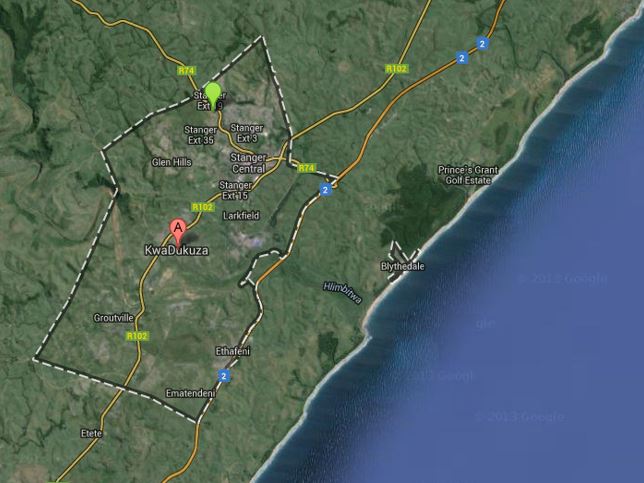
Kwa Dukuza is well known for its rich sugar cane fields and includes a population of 181 000 locals. The Kwa Dukuza Municipality forms part of the iLembe District Municipality area and is situated on the east coast of Kwa-Zulu Natal, between the eThekwini Metro and the Tugela River mouth. Aside from the Kwa Dukuza Municipality, iLembe District Municipality consists of another 3 Local Municipalities namely, Mandeni, Ndwedwe and Maphumulo. Below is an image of the geographical location of the Kwa Dukuza Municipality.

The Kwa Dukuza town is filled with a rich history dating back to as early as the 1800s with the Zulu kingdom as one of the first known inhabitants of the land lead by legendary King of the Zulus, Shaka Zulu. His gravesite, execution cliff and rock on which he sat the day he was killed are some of the most highly valued sites of Kwa Dukuza. The Stanger North Coast Museum was formed to inform all visitors of the powerful legacy of King Shaka and houses many fascinating visuals and ornaments that existed during his time. On 24 September each year, a Shaka Day festival is held at Kwa Dukuza where about 10 000 or more Zulus gather to mark the significance of the Zulu nation and their legendary king. Kwa Dukuza is also famous for being the area from which the former president of the African National Congress (ANC) and Nobel Peace Prize winner, Chief Albert Luthuli, resided. Luthuli is internationally recognized as an outstanding visionary, leader and proponent of human rights and justice. His home in Groutville, Kwa Dukuza, was transformed into a museum in recognition of his efforts and contribution to South Africa’s democracy. A statue of Luthuli as well as his gravesite is also located in Kwa Dukuza. Another highly esteemed leader recognized by Kwa Dukuza and the world is Mahatma Gandhi. Ghandi is globally respected as a leader, lawyer and inspiration for non-violence, freedom and human and civil rights across the globe. Kwa Dukuza recognized the ‘Father of Nation’ (Bapu) by erecting his statue as well as naming a street after this monumental figure. This entices many tourist visits to the area making it an attractive tourist attraction.
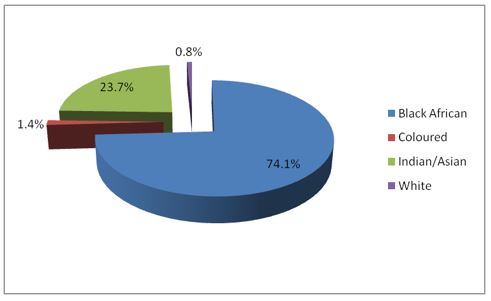
Another distinct characteristic of Kwa Dukuza is its strong eastern flavor that is the result of the European settlers bringing with them Indian workers who labored in the sugar canes. Today, Kwa Dukuza inhabits a large portion of Indian South Africans who have also greatly contributed to the town both economically and culturally. More racial groups arrived in Kwa Dukuza, thus contributing to the diversity in culture and ethnicity. While the most abundant racial and cultural group is the Black Africans followed by the Indian group, the diverse cultural, racial and ethnic groups that exist in this town amplify South Africa’s multiculturalism.
Different races of Kwa Dukuza
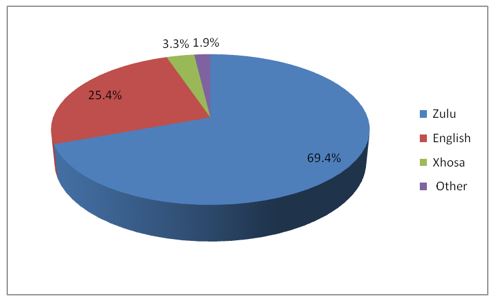
First Languages Spoken in Kwa Dukuza
Some of the key focal points of the industrial sectors in Kwa Dukuza are:
- A major number of land claims that occur in a band from Blythedale Beach to the Kwa Dukuza town which may potentially influence development
- Commercial local level activities exist in all urban and peri-urban areas
- Major development is located in the Kwa Dukuza and Ballito areas
- Agriculture is the key economic sector in Kwa Dukuza and contributes 23% of the total gross domestic product
- Recreation has much potential particularly for tourist attractions such as the beaches, culture and wildlife that is found in the Kwa Dukuza area.